All posts
PLG Onboarding: The First 15 Minutes Determine Your Growth Curve
Blog· Ryan Echternacht·Nov 19, 2025
Ryan Echternacht·Nov 19, 2025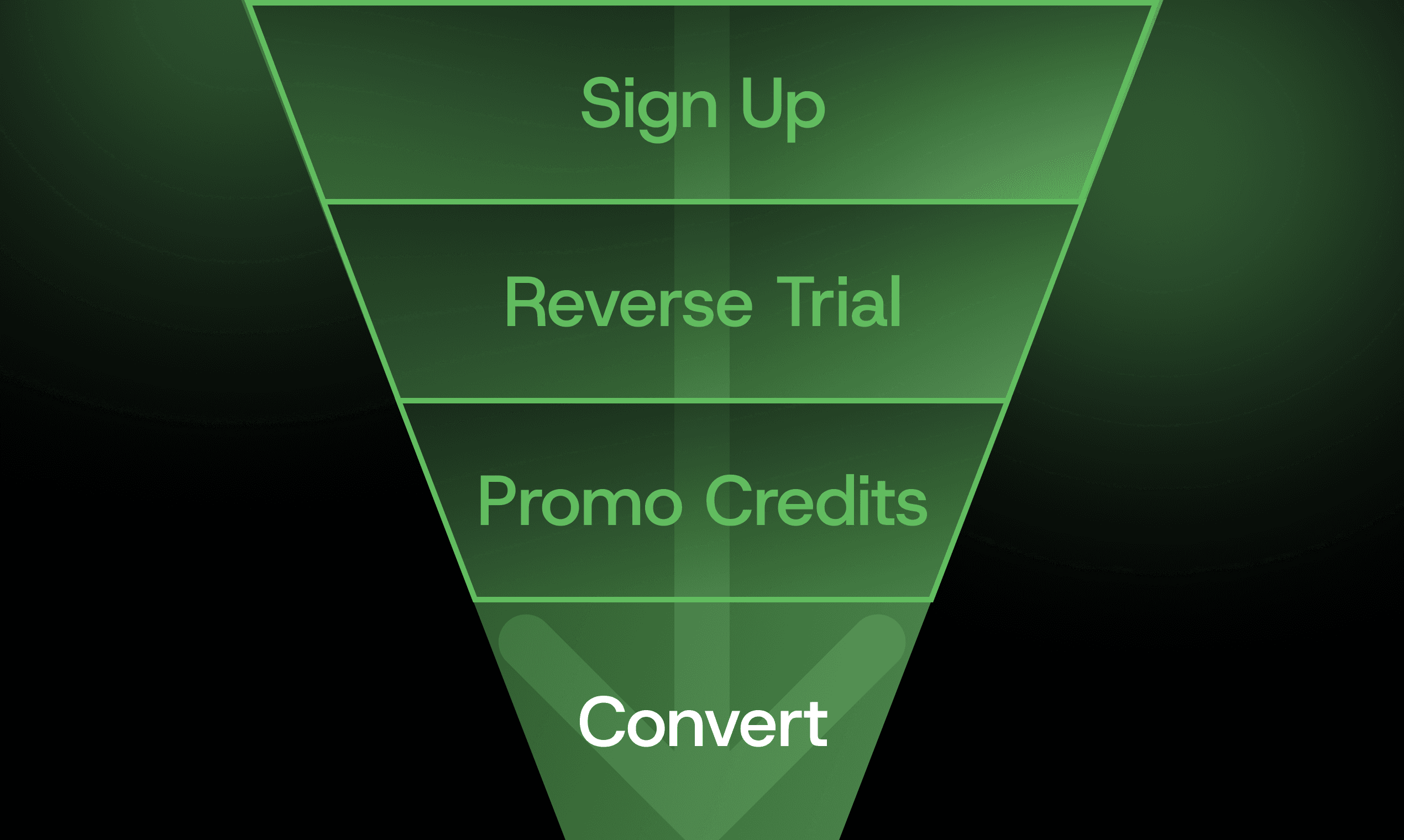
TL;DR: How you introduce a new user to your product sets the tone for activation, expansion, and long-term monetization. Speed in the onboarding process is crucial, as users expect to get value quickly and efficiently within the first moments of their experience. Modern PLG companies use a mix of free plans, trials, reverse trials, and promotional credits to optimize activation while preserving revenue. This guide breaks down the 4 dominant patterns, when to use each, and how to enable teams to iterate quickly on onboarding. Onboarding is a critical business lever for growth.
Why Onboarding Strategy Is Part of Your Pricing Architecture
Most teams treat onboarding as a UX decision or a growth experiment. In reality, it’s a pricing decision.
The plan a new customer lands on determines:
- What features they can try
- How quickly they find value
- How much usage they generate
- How “paid-ready” they feel
- How cleanly you can transition them to your real pricing
The biggest mistake? Hard-coding onboarding logic, which makes every experiment a dev sprint and freezes your ability to iterate. (This is where Schematic’s Initial Plan configuration comes in — but we’ll layer that later.)
The Four Common PLG Onboarding Models
Innovation in platform design has led to new onboarding models that better align with user needs and product-led growth. Below are examples of the most common onboarding patterns used by SaaS and AI products today.
1. The Classic Free Plan
What it is
A permanently free tier with limited entitlements or usage.
Why teams use it:
- Maximizes top-of-funnel acquisition
- Works well when your product has a clear activation moment
- Low friction for self-serve signup
- A simple signup form or well-designed forms can reduce friction and improve user acquisition by streamlining the onboarding process and enhancing user engagement
Best for
- Collaborative tools
- AI/API products where value can be proven at test scale
- Consumer-facing products where the free tier creates a habit before requiring payment
Pitfalls
- Hard to convert if the free tier delivers too much
- Entitlement drift: features meant for paid tiers accidentally stay free
- Requires strong in-product nudges and usage gates to drive upgrades
- Entitlements or access may need to be adjusted dynamically based on user location, which can add complexity to managing access rights
2. Free Plan + Optional Trial
What it is
Users start on the free plan but can opt into a trial of premium features.
Why teams use it:
- Keeps acquisition frictionless
- Lets motivated or curious users "self-upgrade" into a trial
- Filters out low-intent users while rewarding high-intent ones
Best for
- Products where users need to explore the free tier first to understand the premium features
- Encourages trial starts that align with real intent, not arbitrary timers
- Allows you to refine trial value over time without affecting the free tier
Pitfalls
- Requires clear boundaries between "free forever" and "trial only" features
- Heavy engineering effort if feature gating is baked into code
- Trial activation ends up becoming its own funnel you must optimize
- Lacking a robust system to manage trial entitlements and grants of premium access can lead to errors in who receives or loses access, making entitlement tracking and delivery unreliable
3. The Reverse Trial
What it is
Every new user starts on a full-featured paid plan for a limited trial (e.g., 14 days). After the trial, they fall back to the free tier.
Why teams use it:
- Maximizes exposure to premium value
- Creates urgency and a natural upgrade path
- Converts high-intent users quickly while preserving a free safety net
- Encourages users to become paying customers by demonstrating value during the trial
Best for
- Products with "aha" moments that only exist in paid tiers
- AI products where premium usage provides the strongest value signal
- Teams optimizing for maximum expansion potential early
Pitfalls
- Can feel bait-and-switch if the fallback tier is too restricted
- Entitlement cleanup is painful if handled in app code
- Requires precise control over what happens at trial expiration
- Must track account status closely during and after the trial to optimize conversion and user experience
4. Free Plan + Promotional Credits
What it is
Users start on the free tier but receive a temporary pool of credits, usage, or computational allowance.
Why teams use it:
- Lets users try the paid experience without a time limit
- Works especially well for AI/API products where usage = value
- Enables cost-controlled generosity (you choose how many credits to hand out)
- A flexible platform can deliver and manage promotional credits efficiently
Best for
- AI, API, infrastructure, or workflow automation tools
- Data products where value is tied to volume
- GTM teams using promos to drive campaigns, launches, or migrations
- Businesses looking to drive adoption and engagement through promotional credits
Pitfalls
- If not enforced properly, users can bypass usage limits
- Hard to maintain promo logic once you run multiple campaigns
- Without real-time usage visibility, users feel blindsided when credits run out
How to Choose the Right Onboarding Model
Think in terms of value discovery:
- Is your “aha” moment gated behind usage? → Promotional credits
- Is your “aha” moment gated behind features? → Trial or reverse trial
- Does value grow slowly over time? → Classic free tier
- Do high-intent users need a fast path to premium? → Free + optional trial
- Do you want everyone to feel the paid experience right away? → Reverse trial
Your onboarding strategy should reflect how your product creates value, how long it takes to reach activation, and how confident you are in your premium experience.
The Biggest Mistake PLG Teams Make
Most PLG onboarding failures have the same root cause: the onboarding path is hard-coded into the product. When onboarding is rigid, it can undermine user commitment, making it harder to foster long-term engagement and loyalty.
Once your free plan, trial logic, reverse trial behavior, credit allowances, and upgrade prompts are scattered across your codebase, you lose the ability to iterate. And onboarding is something you should be iterating constantly. Building a strong relationship with users during onboarding is crucial, as it encourages open communication, trust, and a positive user experience.
When onboarding is rigid, teams get stuck with patterns that no longer match their product or GTM motion:
- Free tiers stay overly generous because no one wants to untangle legacy entitlements
- Trials become brittle because extending or shortening them requires engineering changes
- Reverse trials feel chaotic because fallbacks aren’t cleanly controlled
- Promo credits turn into one-off hacks instead of repeatable experiments
- Upgrade nudges only appear in places where someone remembered to add them
- Growth experiments stall because every variation becomes a dev sprint
The end result? You stop testing new onboarding flows, and PLG companies that stop testing stop growing.
The solution is simple: treat onboarding as something you can change with configuration, not code.
When teams can adjust plans, generosity, trials, and upgrade paths without rewriting product logic, onboarding becomes a repeatable growth lever instead of an engineering bottleneck. This is exactly what Schematic is built for, giving product and growth teams the ability to test, iterate, and refine onboarding flows without waiting on engineering. Effective onboarding is rooted in the principles of organizational socialization, ensuring users understand their roles, the product's value, and develop a sense of belonging.
Conclusion
The way users first experience your product determines retention, conversion, expansion, and long-term revenue. Just as an organization carefully plans the onboarding of a new hire entering a new job, clarifying the person's position, involving managers, and ensuring smooth integration into the new company or new organization through effective hiring and hire processes, PLG onboarding should be structured to support user success and adaptation. PLG leaders iterate on onboarding just as aggressively as they iterate on features — but you can only iterate quickly if your pricing architecture supports it.
Modern PLG companies treat onboarding as a configurable part of pricing, not as a hard-coded path.