 Ryan Echternacht
A pricing model is how a business charges customers for its product or service.
In Software-as-a-Service (SaaS) and artificial intelligence (AI) companies, this could be a monthly recurring plan, seats, usage, credits, or successful results.
The ideal pricing model helps you grow revenue, increase market share, and improve customer satisfaction by making costs clear and tied to the product value.
This guide explains the definition of a pricing model and how to choose the right one for your organization. We'll also walk you through different SaaS pricing model examples that you can implement.
What Is a Pricing Model?
A pricing model is the method a company uses to determine how customers pay for a product or service. It sets the base charge, so the pricing structure feels clear to buyers and useful for the organization.
SaaS and AI businesses should select a pricing model that suits their target market, the production costs, and the customer’s perceived value of the product.
The goal is to build a framework that teams can use to bill customers accurately.
Is a Pricing Model the Same as a Pricing Strategy?
No, a pricing model is different from a pricing strategy.
A pricing model defines how a company charges customers. It answers the "how" behind pricing.
A pricing strategy explains why the company sets specific price points. The goal is to maximize profits while still catering to customer preferences and price sensitivity.
The pricing model creates the structure, while the pricing strategy is the reason behind the structure.
Below are the different pricing strategies to implement:
- Cost-plus pricing or markup pricing: It's a type of cost-based pricing where you add a profit margin on top of your operational costs.
- Competition-based pricing: Set prices based on similar products in your category to protect market position.
- Value-based pricing: Price services or products based on the customer's perceived value of the product.
- Penetration pricing: Set a low price to attract customers and claim market share before your competitors.
- Price skimming: Start with a high price to target customers who are willing to pay for early access, then lower prices over time.
- Dynamic pricing: It's the opposite of fixed pricing because it constantly adjusts charges based on market demand or usage patterns.
- Bundle pricing: Combine multiple products or services and sell them for one price.
Most Common Pricing Models Used by SaaS and AI Companies
Here are the different pricing models that most SaaS and AI companies use.
Subscription Pricing
Subscription-based pricing involves charging customers on a predefined billing cycle, usually monthly or yearly.
This pricing model fits SaaS platforms with steady usage, clear plans, and fixed value. It gives the business predictable revenue and improves cash flow.
Customers can easily understand and predict subscription pricing. They already know how much they will pay for each billing cycle.
However, flat-fee subscriptions do not fit AI products because of probabilistic workflows and unpredictable gross margins. Customers with heavy usage can hurt business profits if they pay the same fixed fee as light users.
Plus, subscription-based pricing does not always scale with business value, making it harder to grow revenue from existing customers.
Tiered Pricing
Tiered pricing groups product access into plans at different prices. A basic plan may include core features, while higher-tier plans offer premium features and better support.
A tiered pricing model works well when you sell to more than one type of customer. For example, a lower-cost plan can cater to startups or hobbyists. An advanced plan with premium pricing can target enterprise customers who might need admin controls, service-level agreements, and 24/7 support.
Buyers can freely choose the plan that fits their needs.
Tiered pricing also provides a clear path for upgrades as customers grow, need more access, or want more value from the product.
The downside is that expansion slows when customers reach the highest tier. Power users may also consume more resources without paying in proportion to their actual usage.
Per-Seat Pricing
In a seat-based pricing model, customers pay for each user who needs software access.
This model suits products where value grows as more people use the platform. It is common for project management tools, sales tools, customer support platforms, and communication software.
Per-seat pricing is easy to explain because customers can connect pricing to team size. It's also easy to predict the revenue the business will earn.
However, seat-based pricing does not make sense for AI products because they are meant to replace human users. It also breaks down when customer usage varies a lot. One user may create far higher costs than another account.
Usage-Based Pricing
Usage-based pricing means SaaS and AI companies charge customers for actual product consumption.
Usage can refer to many things inside the product. Popular examples include API calls, tokens, storage, workflows, compute time, or monthly active users (MAUs).
Usage-based pricing protects gross margins when operational costs increase with customer activity. It also supports product-led growth since customers can pay as they go without a large upfront commitment.
This model can sit beside project-based pricing when customers pay for a defined scope plus extra usage beyond the agreed terms.
That said, usage-based pricing is not the best pricing model for every business. Total income earned can fluctuate every month, which makes it difficult to predict revenue growth.
There is also the risk of billing disputes when a customer's invoice includes unexpected usage charges. This is why it's important to provide clear limits, proactive alerts, and real-time usage dashboards.
Credit Burndown Pricing
In credit burndown pricing, customers buy credits upfront or receive credits as part of a subscription plan. These credits are consumed every time the user performs an action, such as generating an AI image or making an API call.
Credit-based pricing is popular among AI products because each action may have a different cost. It introduces predictability without exposing raw costs. At the same time, it gives customers flexibility over their usage. They can plan their spending and decide when to top up credits based on their needs.
Credit burndown pricing suits companies that want customers to prepay and use credits across several features.
However, this pricing model requires accurate usage tracking inside the product. It can also confuse customers when it comes to credit resets and expirations.
Hybrid Pricing
Hybrid pricing combines two types of pricing models. A company may charge a base subscription plus implement usage fees, credit burndown, or overage pricing.
Hybrid monetization works well for SaaS and AI companies that need both predictable revenue and room for usage growth. It gives customers a clear starting price point while capturing upside when usage increases.
The tradeoff is that billing rules must be clear to prevent disputes and customer friction. Businesses also need a reliable billing solution that can handle recurring charges and meter usage simultaneously.
Freemium Pricing
Freemium pricing provides free access to the basic version of the product. Then, it charges customers who need access to premium features, higher limits, more seats, or better support.
This pricing model is recommended when the product is easy to try and when users can reach value without contacting sales teams. It can support product-led go-to-market strategies.
Freemium pricing needs careful limits. If the free plan gives away too much value, users may not upgrade to a paid plan.
Free access can also spike costs for AI companies. It's important to use paywalls strategically to convert free users to paid customers.
Outcome-Based Pricing
Outcome-based pricing is a model that charges customers based on results.
Instead of paying for seats, software access, or usage, customers pay when the product completes a task, books a qualified lead, resolves a support ticket, saves money, or generates revenue.
According to the 2026 State of AI report, cost savings (36%) and revenue generated (18%) are two common ways companies define outcomes. This report shows that pricing is now often tied to demonstrable business value instead of feature access.
While outcome-based pricing can be powerful, it needs clear tracking. Both the business and the customer should agree on what counts as a valid result. It is best for products where outcomes are easy to define, prove, and connect to customer value.
Tips for Choosing the Right Pricing Model
Below are eight tips you can follow to select the ideal pricing model for your SaaS or AI company.
1. Identify Your Value Metric
Determine the value customers want to pay for, not the feature you find easiest to bill for.
For SaaS platforms, that may be team output, projects completed, records managed, or data stored. AI products are usually valuable for tasks completed, model calls, or workflows automated.
Make sure the metric connects to your product's unique value proposition. Customers should be able to understand it quickly and plan their budget with confidence.
It should also grow with customer value. If usage increases but revenue stays flat, the metric may be a poor fit.
Plus, a strong value metric should support different customer segments. A startup, a fast-growing team, and an enterprise account may value the same product in different ways.
2. Understand Your Cost Structure
Know what it costs to serve each customer before you set prices.
SaaS businesses usually pay for support, hosting, storage, and sales costs. AI companies often have additional fees tied to model calls, tokens, compute, output size, and context windows.
By understanding your current pricing structure, you can make pricing decisions that protect gross margins. For example, a fixed recurring fee may work when costs are stable. Usage-based or credit-based pricing might be a better fit when costs increase with customer activity.
You should consider both low-usage and high-usage customers. Power users can hurt margins if pricing does not scale with cost. Your model should support growth without letting usage costs outrun revenue.
3. Evaluate Competitor Pricing
Review how similar companies price their products or services. Look at plan names, price points, usage limits, add-ons, and enterprise offers to learn what buyers already expect.
Teams also use competitor pricing for brand positioning. Higher price points may indicate a premium or luxury positioning, implying a higher-quality product. Low prices signal a penetration strategy and are used to acquire market share.
However, do not blindly copy another company’s pricing. Their production costs, customer base, and business goals may be different from yours. Use competitors as a reference point, then check other market trends before deciding on your own pricing.
4. Conduct Market Research
Talk to customers before you lock in pricing. Ask what they value most, what feels fair, and what pricing terms would slow down a purchase. This helps you understand actual consumer demands before launch.
Market research can include sales calls, win-loss notes, surveys, interviews, and A/B tests of pricing pages.
You should also monitor market conditions. Customer budgets, operating costs, and product demand can change. Pricing should reflect what customers are willing to pay now instead of what might have worked months ago.
5. Match Pricing to Customer Segments
Customers expect several pricing options that can be customized to their actual needs.
A startup may want a simple self-serve plan. A growing team may need higher limits and admin controls. An enterprise buyer usually looks for custom terms, advanced security, and premium support.
Your pricing should match customer expectations in each segment. If small buyers only see custom plans with enterprise pricing, they may leave. If large organizations don't see an enterprise option, they may doubt the product can support their demands.
Group customers by size, use case, budget, and industry. Then, create plans or packages that fit each group.
6. Assess Billing Complexity
Before you choose a pricing model, ask whether your billing system can support it. A simple subscription plan may be easy to manage. However, usage-based, credit burndown, and hybrid pricing need careful setup.
You should also check if the billing platform can meter usage accurately. For SaaS and AI products, this means tracking the right events, linking them to the right account, and turning them into billable usage.
Evaluate whether you can enforce plan limits and software entitlements in real time. If a customer reaches a usage cap, credit limit, or feature limit, your product should respond right away.
Without entitlement checks, customers may overuse the product, which can hurt margins and increase the risk of billing disputes.
7. Run a Test Before a Full Launch
Test pricing before you roll it out to your entire customer base. Run a pilot with new customers or beta users.
Then, gather customer insights from sales calls, support tickets, product usage, and churn notes. Study how buyers react to the price, plan limits, and value metric. If they ask the same questions often, your pricing may need work.
A thorough test should show whether the pricing model is easy to sell and strong enough to support future growth.
8. Implement Pricing and Monitor Performance
After testing, you can officially launch your selected pricing model. But your work doesn't stop there.
Make sure you track how pricing performs. Look at conversion rates, churn rates, expansion revenue, average revenue per account, and gross margins. These numbers show whether pricing is helping or hurting business growth.
Pricing should also not stay fixed. Product value changes. Operational costs increase. Customer behavior shifts.
Iterate on pricing and packaging to better match customer value, protect margins, and create clearer upgrade paths.
Schematic Lets You Launch Any Pricing Model Without a Billing Rebuild
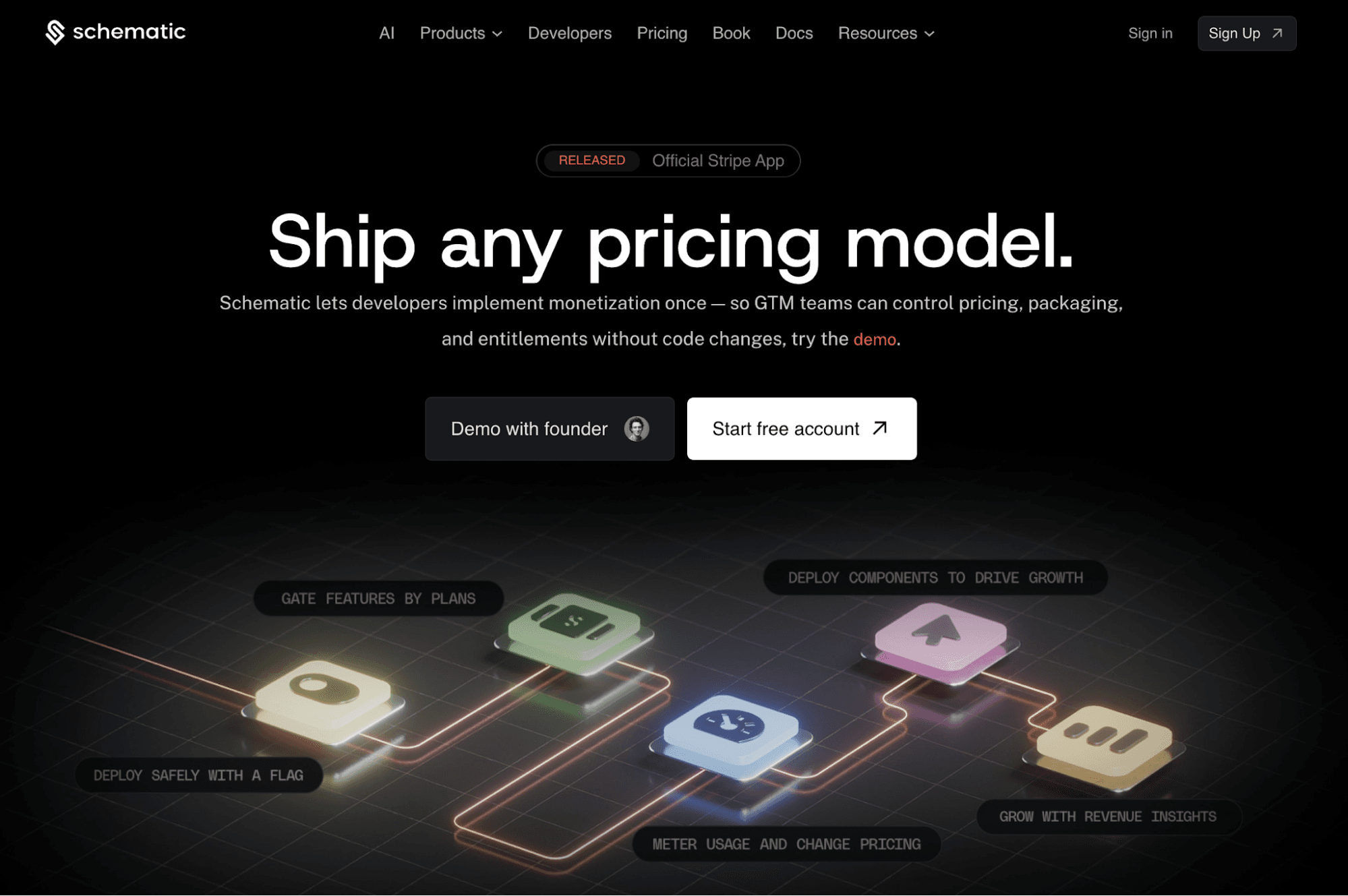
Schematic helps modern SaaS and AI companies ship any pricing model without rebuilding their billing stack.
It works by decoupling pricing logic from the application. Teams can launch flat-fee subscriptions, pay-as-you-go pricing, seat-based models, credit burndown, and overages in days, not weeks.
Schematic also acts as the system of record for plans, add-ons, credits, SaaS entitlements, limits, and overrides. Commercial teams can run pricing tests, launch trials, and control feature access without waiting on developers.
Schematic is built on Stripe, so you can continue using the latter for payment processing, invoice generation, tax management, and revenue recognition.
Schematic extends Stripe billing with usage metering, limit enforcement, credit ledger, customer lifecycle management, embeddable checkout components, and revenue insights.
FAQs About What Is a Pricing Model
What is the meaning of a pricing model?
A pricing model refers to the structural framework a company uses to bill customers. It defines how buyers pay for a product or service, such as access, seats, usage, credits, or results.
What are examples of pricing models?
Common pricing model examples include subscription pricing, tiered pricing, per-seat pricing, usage-based pricing, credit burndown pricing, hybrid pricing, freemium pricing, and outcome-based pricing. SaaS and AI companies often combine two or more pricing models to match customer needs and product costs.
What are the four types of pricing strategies?
The four common types of pricing strategies are cost-plus pricing, competitor pricing, value-based pricing, and dynamic pricing. Each one sets prices from a different angle, such as cost, competitors, customer value, or market demand changes.