Usage-Based Pricing: A Short Guide for SaaS and AI
Learn how usage-based pricing works and explore its types. Discover how Schematic can help you set up usage-based pricing with ease.
 Ryan Echternacht

On this page
- Overview
- TL;DR
- What Is Usage-Based Pricing?
- Why SaaS and AI Companies Are Moving Beyond Flat Fees
- Examples of Usage-Based Pricing
- Common Usage-Based Pricing Models
- Pay-As-You-Go (PAYG)
- 2. Overage Pricing
- 3. Tiered Pricing (Graduated or Volume)
- 4. Credit Burndown
- How to Choose the Right Usage-Based Pricing Model
- How to Implement Usage-Based Pricing
- Common Challenges With Usage-Based Pricing
- Launch Usage-Based Pricing Your Enterprise Customers Can Trust With Schematic
- FAQs About Usage-Based Pricing
- What are some examples of usage-based pricing?
- What is a usage-based pricing model?
- Can you give me an example of usage-based billing?
- What is the difference between usage-based pricing and subscription pricing?
Usage-based pricing means customers pay for what they use. It's increasingly popular among SaaS and AI companies because product value and activity can vary considerably between customers.
Traditional seat-based pricing made sense when headcount drove adoption, and marginal costs were low. Today, costs and value often depend on backend activity, such as API calls, AI tokens, or compute time.
For software businesses, the shift creates opportunities to connect pricing more closely to customer usage. It also introduces challenges around billing accuracy, spending predictability, and managing complex pricing models.
This guide covers common usage-based pricing models, real examples, and how to choose the right approach for your product.
TL;DR
Usage-based pricing charges customers according to actual consumption, such as API calls, AI tokens, or data storage.
Common usage-based pricing models include pay-as-you-go, overage pricing, tiered pricing, and credit-based pricing.
Usage pricing can support revenue growth and customer satisfaction by connecting charges to product usage.
Accurate usage tracking, automated alerts, and spending controls help prevent customer bill shock.
Schematic helps SaaS and AI companies manage usage-based billing while giving enterprise customers real-time visibility and control over spending.
What Is Usage-Based Pricing?
Usage-based pricing is a pricing model where customers pay based on how much of a product or service they consume.
Unlike traditional subscription models that charge a flat fee, usage-based pricing charges customers according to measurable activities during a billing period.
These activities might include API requests, AI tokens, data processed, or storage consumed.
For example, an AI platform could charge customers based on the number of tokens processed, while a cloud storage provider might bill according to gigabytes stored.
Also called consumption-based pricing, this model works well when actual usage closely reflects customer value or the cost of delivering a service.
Why SaaS and AI Companies Are Moving Beyond Flat Fees
Flat fees and seat-based pricing can be limiting when customers consume vastly different amounts of resources.
For example, two companies might have the same number of users, but one processes ten times as many API requests. Charging both businesses the same amount may not reflect their actual consumption or the costs involved.
According to McKinsey's 2025 research on software business models, consumption-based pricing is becoming more relevant as AI products take on tasks with varying resource requirements.
Usage-based pricing allows SaaS companies to capture revenue as customer activity increases. It can also help businesses serve customers with different usage patterns and budgets.
However, the billing system needs to track usage accurately and provide enough transparency for customers to understand their costs.
Examples of Usage-Based Pricing
Usage can mean different things depending on your product. Common usage metrics include API calls, tokens, processing minutes, gigabytes, events, and completed actions.
Here are some usage-based pricing examples:
Twilio: Charges per SMS message sent and, in many cases, received. Rates vary by country, so spending changes with message volume.
Postmark: Charges based on email volume, with included allowances and additional usage fees as customers send more messages.
AWS: Meters cloud services such as data storage, requests, data transfer, and compute time.
Vercel: Uses consumption metrics such as function execution and bandwidth to calculate usage-based charges.
OpenAI and Anthropic: Offer token-based pricing where input and output tokens have separate rates.
Synthesia: Uses video generation minutes and credits to measure consumption under its pricing plans.
Utilities: Electricity and water providers charge for measured consumption, sometimes with an additional base fee.
Uber: Calculates fares using factors such as trip distance, duration, and demand.
Each example connects pricing to measurable activity, although the specific billing rules differ.
Common Usage-Based Pricing Models
Usage-based pricing comes in several forms. The right pricing structure depends on how you measure consumption, how predictable customers want their bills to be, and the complexity your team can manage.
Pay-As-You-Go (PAYG)
Pay-as-you-go is one of the simplest ways to introduce usage-based pricing.
You choose a usage metric, set a public rate, track consumption during each billing cycle, and calculate charges based on actual usage.
For example, if you charge $0.01 per API call, a customer making 10,000 calls pays $100.
Pure usage-based pricing is easy to explain and works well when one or two usage metrics closely reflect product value.
However, usage spikes can lead to unexpected bills if customers cannot monitor consumption.
2. Overage Pricing
Overage pricing gives customers a fixed usage allowance under their existing subscription plan. Additional consumption is charged at a predefined rate.
For example, a subscription might include 10,000 API calls per month, with an extra fee for every call beyond that limit. Customers get a predictable starting cost, while your business can generate additional revenue as usage increases.
This hybrid pricing model works well for SaaS companies that want to combine recurring revenue with flexible usage-based charges.
Clear usage thresholds and automated alerts can also help customers avoid unexpected overage fees.
3. Tiered Pricing (Graduated or Volume)
Tiered pricing divides product usage into different levels, with the per-unit cost typically decreasing as consumption grows.
For example, your pricing structure might charge $1 per unit for the first 100 units and $0.90 for higher volumes.
Volume pricing applies the rate of the final tier reached to all eligible units. Graduated pricing charges units according to the tier they fall into.
Both approaches can reward higher usage and provide volume discounts.
Tiered pricing is useful when you serve customers with different consumption levels and want pricing to reflect their scale.
4. Credit Burndown
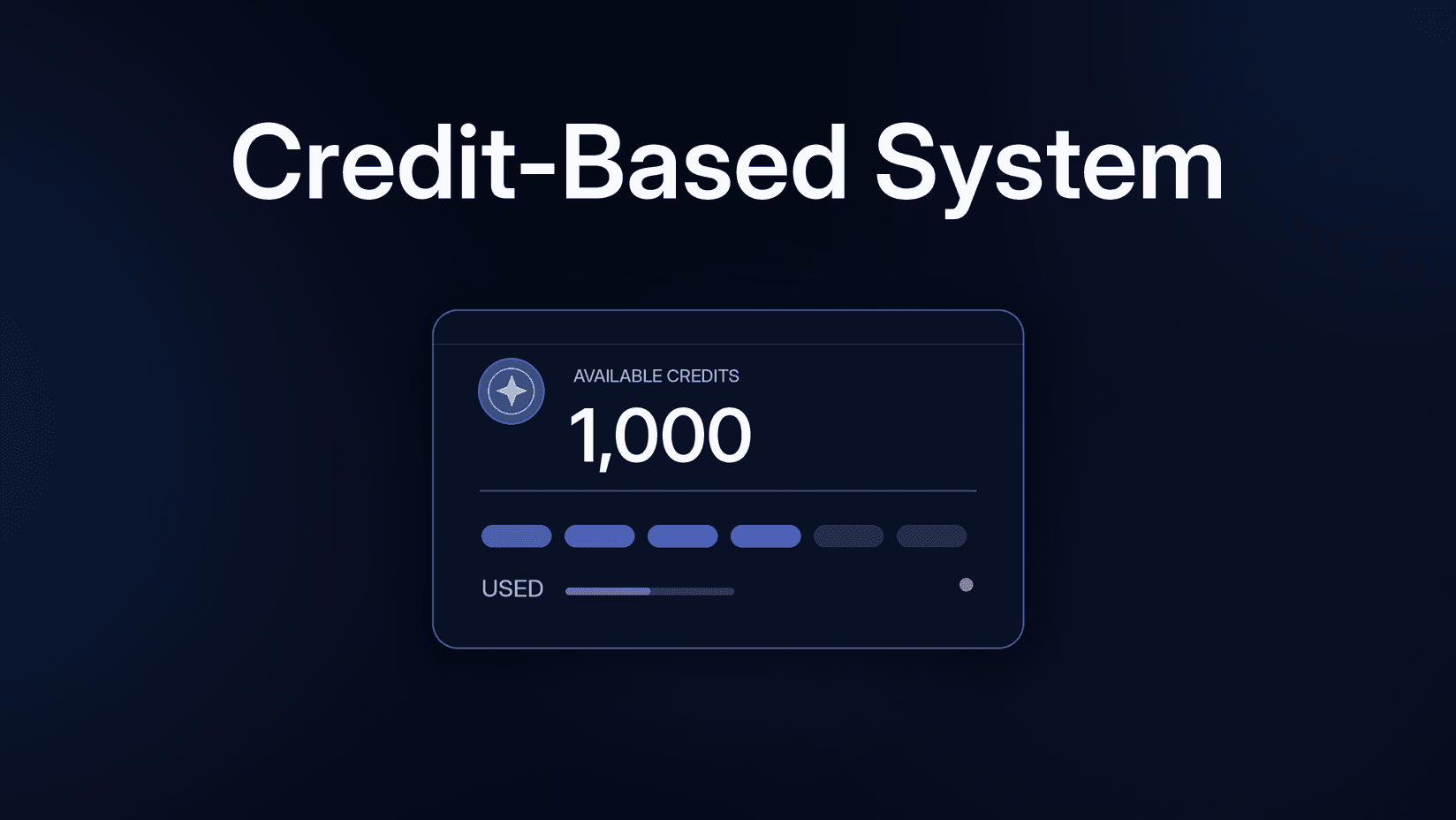
Credit burndown is a consumption-based pricing model where customers purchase credits and spend them as they use your product.
Rather than displaying separate costs for every API call, token, or AI action, you assign a credit value to different activities.
For example, generating an AI report might cost five credits, while processing a document costs two.
Customers can monitor one credit balance, even when using several features.
Prepaid credit models are useful for AI products with multiple billable actions and variable usage. Customers pay upfront, giving them a clearer spending budget.
Your billing platform must track credit consumption, remaining balances, and expiration rules accurately.
How to Choose the Right Usage-Based Pricing Model
Choosing a pricing model starts with understanding how your customers use your product.
Your pricing should reflect the activities customers value while giving them enough control over their spending.
Consider these questions:
What drives customer value? Identify measurable activities, such as API calls, AI tasks, or data processed.
How predictable is usage? Consistent usage may fit subscription pricing with overages, while variable usage may benefit from prepaid credits.
Do customers need volume discounts? Tiered pricing can reward customers who consume more.
How many billable actions do you offer? Credit-based or hybrid models can simplify billing when customers use several features.
Can customers monitor spending? Real-time usage data, usage alerts, and spending limits help reduce unexpected charges.
Start with the simplest pricing model that supports your product and customer needs. You can introduce additional pricing rules as your business grows.
How to Implement Usage-Based Pricing
Implementing usage-based pricing requires more than choosing a rate for each API call or unit consumed.
Your billing system needs reliable usage data and pricing rules that calculate charges accurately.
Start with these steps:
Choose a usage metric: Identify the activity that best reflects customer value, such as tokens processed or storage consumed.
Track actual usage: Set up a metering system to capture consumption events during each billing period.
Define pricing rules: Choose between pure usage-based models, tiered pricing, prepaid credits, or hybrid pricing.
Set usage limits: Offer alerts, spending caps, or usage thresholds to help customers control costs.
Test your billing process: Check that usage data translates into accurate charges and invoices.
Review performance: Monitor customer usage patterns, revenue growth, and customer feedback.
Your first usage-based pricing strategy may need adjustments as actual demand changes.
Make sure your billing platform supports pricing updates and custom agreements as your customer base grows.
Common Challenges With Usage-Based Pricing
Usage-based pricing can support revenue growth, but it also introduces operational challenges.
Unpredictable bills: Customers may struggle to estimate costs when consumption changes frequently. Usage forecasts and spending limits can help.
Inaccurate usage tracking: Missing or duplicated usage events can result in incorrect charges and billing disputes.
Revenue predictability: Finance teams may find it harder to forecast monthly revenue or annual recurring revenue when customer consumption varies.
Complex billing: Managing multiple usage metrics, hybrid pricing, and prepaid credits can complicate the billing process.
Pricing changes: Adjusting usage rates, billing rules, or plan limits can become time-consuming when pricing logic is hardcoded into your application.
Customer bill shock is another concern, particularly for AI products where consumption can increase unexpectedly.
Real-time usage data, automated alerts, and configurable limits give customers more control over their spending.
Clear usage pricing also helps maintain customer satisfaction and trust as your product grows.
Launch Usage-Based Pricing Your Enterprise Customers Can Trust With Schematic
Your usage-based pricing strategy will evolve as customers use more of your product. Keeping billing accurate and spending predictable becomes increasingly important as you grow.
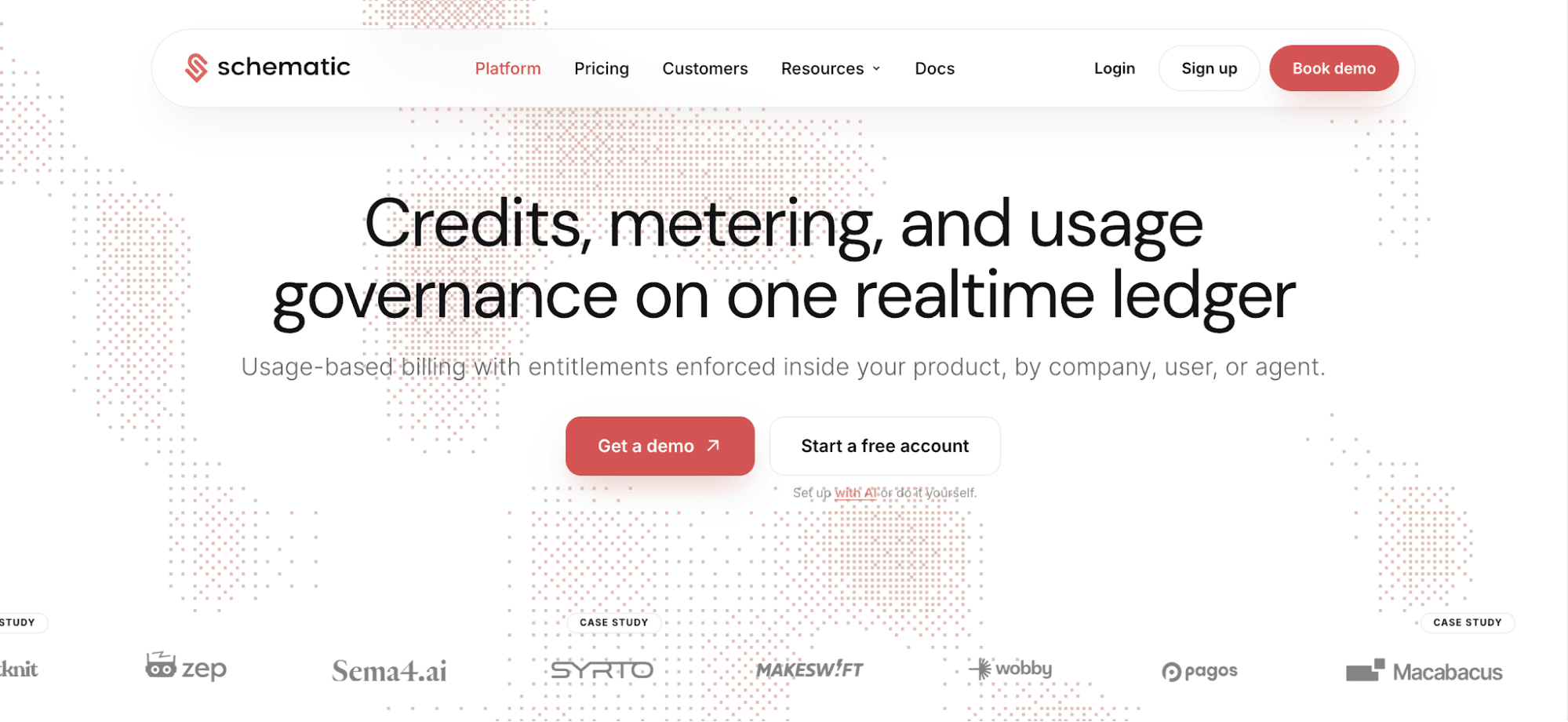
Schematic is a complete usage-based billing platform for software and AI companies selling to enterprises.
It helps you meter usage, manage flexible pricing models, automate billing, and enforce product limits in real time.
With Schematic, you can:
Manage usage-based billing: Track product consumption and calculate customer charges.
Configure pricing models: Support usage-based, credit-based, seat-based, and hybrid pricing.
Offer enterprise credit wallets: Give customers real-time usage visibility, spending forecasts, and configurable limits.
Enforce usage limits: Apply spending controls and product restrictions as consumption increases.
Update pricing plans: Change pricing, packaging, and customer agreements with less engineering work.
Max Ade, Co-Founder & CEO of Pickleheads, explains:
"With Schematic, pricing changes and experiments are really easy to execute, and we iterated on our pricing model in the first week after launch."
FAQs About Usage-Based Pricing
What are some examples of usage-based pricing?
Examples include Twilio charging per SMS message, AWS billing for cloud resources, and OpenAI charging for tokens processed. These usage-based pricing examples show how customers pay based on actual consumption instead of a fixed subscription fee.
What is a usage-based pricing model?
A usage-based pricing model charges customers according to how much of a product or service they consume. Common usage metrics include API calls, data storage, and AI tokens. Charges depend on actual usage during a billing period.
Can you give me an example of usage-based billing?
An AI company might charge $0.01 per 1,000 tokens processed. If a customer uses 500,000 tokens during a billing cycle, the usage-based charge would be $5. The billing system tracks consumption and calculates the final amount.
What is the difference between usage-based pricing and subscription pricing?
Subscription pricing typically charges a fixed recurring fee for access to software. Usage-based pricing charges according to actual consumption. SaaS companies can also combine both approaches through hybrid pricing models that include a base subscription and additional usage charges.