Credit-Based System: Benefits and Examples for SaaS
Learn what a credit-based system is and how it works. Discover how Schematic can help you set it up and provide users with more control over spending.
 Ryan Echternacht
On this page
- Overview
- TL;DR
- What Is a Credit-Based System?
- Examples of Credit-Based Pricing in SaaS
- Why SaaS Companies Use Credit-Based Systems
- How Does a Credit-Based Pricing Model Work?
- How to Design an Effective Credit-Based System
- 1. Make Credit Values Easy to Understand
- 2. Show Credit Balances and Usage in Real Time
- 3. Set Clear Rules for Unused Credits
- 4. Support Product-Led and Sales-Led Growth
- 5. Price Credits Based on Customer Value
- 6. Adjust Credit Pricing as Usage Changes
- What Infrastructure Does a Credit-Based System Need?
- How Do Credits Affect Revenue Recognition?
- When Credit-Based Pricing Doesn't Make Sense
- Manage Credit-Based Billing With Schematic
- Give Enterprise Customers More Control Over Their Credit Spending
- FAQs About Credit-Based System
- What is a credit-based pricing model?
- How is credit-based pricing different from usage-based pricing?
- What kinds of SaaS products benefit from credit-based systems?
- How do I make credit usage clear and trustworthy?
- Can I use credits for free trials and onboarding?
Credit-based pricing is gaining traction among SaaS companies, especially those offering AI products where usage can be difficult to predict and varies significantly between customers.
A credit-based system lets customers purchase a set amount of credits upfront and spend them on different features or services. Flexible credit packages allow both light and heavy users to choose options that fit their needs.
The concept isn't new. Credit-based models have been used in consumer products, including mobile games and productivity tools, for years.
Today, SaaS and AI companies are adopting credit pricing to simplify billing, combine multiple usage metrics, and give customers greater control over spending.
This guide explains how credit-based systems work, their benefits, potential challenges, and how to decide if the model fits your SaaS business.
TL;DR
A credit-based system lets customers purchase or receive credits that are deducted as they use specific product features or services.
Credit-based pricing is useful for SaaS and AI products with variable usage, multiple billable actions, and complex pricing requirements.
Benefits include predictable spending, flexible pricing, easier onboarding, and support for self-serve and enterprise customers.
Managing credits requires accurate usage metering, credit ledgers, real-time balance tracking, and clear expiration rules.
Schematic helps SaaS and AI companies manage credit-based billing with enterprise credit wallets, real-time usage controls, and flexible pricing models.
What Is a Credit-Based System?
A credit-based system is a pricing structure where customers purchase or receive credits that they use to access different product features or services.
Each action consumes a predefined number of credits. For example, generating an AI report might cost five credits, while exporting a document uses one credit.
As customers use your product, their credit balance decreases until they need to top up, renew, or purchase more credits.
This differs from postpaid usage-based billing, where customers typically receive charges after consuming resources.
Credits also simplify pricing when a product includes multiple usage metrics. You can assign different credit costs to API calls, data processing, or premium features while giving customers one balance to manage.
Examples of Credit-Based Pricing in SaaS
Credit-based pricing works for software products with measurable activities. Each credit represents a defined amount of product usage or access.
Here are examples of how businesses can structure credit consumption.
SaaS Category | Credit Usage Example | What It Simplifies |
Design tools | 1 credit = 1 high-resolution export | File size and processing costs |
Email marketing | 1 credit = 100 emails sent | Message volume and provider costs |
Data enrichment | 2 credits = 1 company lookup | Data volume and source costs |
Scheduling platforms | 5 credits = 1 branded booking page | Premium features and integrations |
PDF generation APIs | 1 credit = 1 PDF rendered | File complexity and page count |
Video platforms | 10 credits = 1 minute of HD transcoding | Resolution and compute costs |
Analytics tools | 1 credit = 10,000 events processed | Event volume and retention costs |
AI platforms | 1 credit = 1,000 tokens generated | Model usage and infrastructure costs |
These are illustrative pricing examples, not actual vendor rates.
A shared credit balance can also allow customers to spend credits on several features, which makes consumption easier to manage.
Why SaaS Companies Use Credit-Based Systems
Credit-based models offer SaaS companies more flexibility in how they charge for usage while giving customers greater control over their budgets.
Here are some benefits of credit-based pricing:
Predictable spending: Customers purchase a fixed number of credits and consume them at their own pace. Spending is easier to budget even when usage varies.
Simpler pricing: Credits combine different billable activities into one currency, reducing the need for separate rates for every feature.
Easier onboarding: Free credits let new users explore your product before purchasing a plan.
Flexible pricing changes: You can adjust credit costs as features and customer usage patterns evolve, subject to existing agreements.
Support for different customer segments: Individual users can purchase small credit packs, while enterprise customers can negotiate larger commitments and volume discounts.
Credit-based systems can also support hybrid pricing by combining subscriptions with prepaid usage allowances.
According to the 2025 State of B2B Monetization report, hybrid pricing adoption among surveyed software companies increased from 27% to 41%. Credits offer one way to combine recurring subscriptions with usage-based charges.
How Does a Credit-Based Pricing Model Work?
A credit-based pricing model turns product activity into a standardized credit value. You first decide how many credits customers receive or purchase. Next, you assign a credit cost to each billable action.
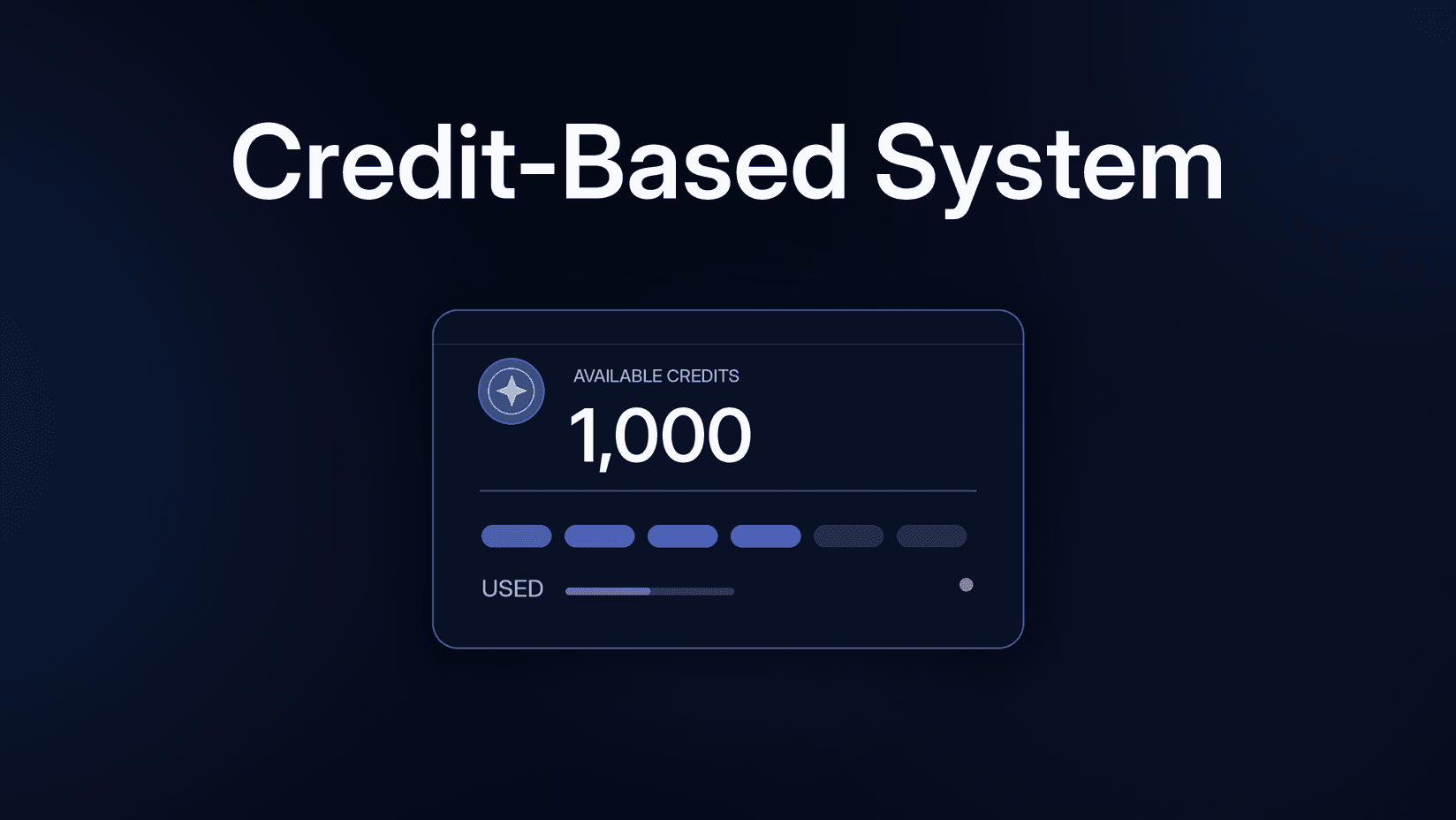
For example, suppose your AI product offers a package of 1,000 prepaid credits for $100.
A customer generates 20 reports, with each report costing five credits. They spend 100 credits and have 900 remaining.
Your credit system records each transaction and updates the balance as the customer uses your product. When credits run low, customers can purchase additional credits or upgrade their plans.
The model also requires clear rules for unused credits, expiration dates, and top-ups.
How to Design an Effective Credit-Based System
A credit-based system gives you flexibility, but it also introduces decisions about pricing, usage tracking, and customer expectations.
Here are the main considerations when designing your model.
1. Make Credit Values Easy to Understand
Credits should make your pricing easier for customers to understand.
If users cannot tell what one credit buys or how many credits they need for an action, pricing can become confusing.
Most customers won't know the technical details behind tokens, embeddings, or computing resources.
Connect credit costs to recognizable activities, such as one credit per export or ten credits per 1,000 events processed.
Tip: Show clear credit pricing examples on your pricing page so customers can estimate costs before making a purchase.
2. Show Credit Balances and Usage in Real Time
Customers should always know how many credits they have left.
Real-time usage dashboards, credit balances, and low-balance alerts help prevent unexpected interruptions.
If someone has 100 remaining credits, they should be able to see how their recent activity affects that balance.
You can also encourage customers to top up before credits run out.
Ideally, they should be able to purchase more credits directly inside your product.
Tip: Display remaining credits, recent transactions, and estimated future consumption in one place.
3. Set Clear Rules for Unused Credits
Credit expiration, rollovers, top-ups, and refunds can affect how customers perceive your pricing.
For example, will unused credits roll into the next billing period? Can customers transfer credits between accounts?
You also need to decide when credits expire and how purchases affect existing balances.
Without clear policies, customers may lose access unexpectedly or question why their unused credits disappeared.
Tip: Define rollover, expiration, refund, and credit transfer policies before launching your pricing model.
4. Support Product-Led and Sales-Led Growth
Credit-based systems can support both self-serve customers and enterprise buyers.
You might provide free credits during onboarding, allowing users to experience your product before paying.
Larger customers can purchase committed credit packages with negotiated pricing.
The same credit system can support trials, upgrades, custom agreements, and recurring subscriptions.
Your team can also offer additional credits during promotions or as part of enterprise contracts.
Tip: Keep credit values consistent where possible and adjust package sizes or discounts to serve different customers.
5. Price Credits Based on Customer Value
Credit costs don't always need to match your underlying infrastructure expenses.
For example, generating a report may have a low computing cost but provide substantial business value to the customer.
Credits give you room to price features based on perceived value while accounting for operational costs.
This also supports more flexible pricing as your product evolves.
However, credit costs should remain understandable and reasonable for customers.
Tip: Review customer behavior, product costs, and perceived value when deciding how many credits each feature consumes.
6. Adjust Credit Pricing as Usage Changes
You probably won't get every credit price right when launching your product.
As usage data accumulates, you may find that customers consume certain features more frequently than expected.
You might need to adjust credit costs or change how many credits are included in each plan.
A flexible credit-based pricing model allows your team to make these changes without rebuilding the entire billing system.
Still, changing credit values can affect customer expectations and existing agreements.
Tip: Start with reasonable credit allowances, monitor consumption patterns, and communicate significant pricing updates clearly.
What Infrastructure Does a Credit-Based System Need?
Credit pricing affects how your product, billing, and finance systems work together.
Unlike simple subscriptions, credits require accurate tracking and real-time enforcement.
Here are the main components you'll need:
Credit ledger: Records purchased credits, usage deductions, adjustments, and remaining balances.
Real-time usage metering: Captures customer activity and calculates how many credits each action consumes.
Usage limit enforcement: Restricts access or prompts customers to top up when their credits run out.
Internal management tools: Give finance and customer support teams visibility into balances, usage history, and manual adjustments.
Flexible billing rules: Manage expiration, rollovers, credit packages, and custom customer agreements.
Traditional subscription systems may require additional development to support these capabilities.
Your billing platform should also connect credit consumption with product access, so customers receive the services they've paid for.
How Do Credits Affect Revenue Recognition?
Selling prepaid credits gives SaaS companies access to cash upfront, but collecting payment doesn't necessarily mean you can immediately recognize the full amount as revenue.
Revenue recognition depends on the services promised, contract terms, and applicable accounting standards.
For example, your finance team may need to recognize revenue as customers spend credits and receive the underlying services.
Unused credits and expiration policies can also affect how you account for deferred revenue and customer balances.
Accurate credit ledgers help finance teams reconcile purchased credits, actual usage, refunds, and remaining obligations.
If you're implementing credit pricing, involve your accounting team early to establish appropriate revenue recognition policies.
When Credit-Based Pricing Doesn't Make Sense
Credit-based systems offer flexibility, but they can introduce unnecessary complexity for certain products.
Here are a few situations where another pricing model may be a better fit:
Your product has one simple usage metric: If customers pay per message, request, or active user, usage-based pricing may be easier to understand.
Customers expect complete cost transparency: Technical buyers may prefer seeing direct usage rates instead of converting activity into credits.
Usage remains relatively consistent: If customers consume roughly the same amount every month, a fixed subscription may be simpler.
Credit balances require too much explanation: Complicated conversion rates, expiration policies, and deductions can make purchasing decisions harder.
For products with straightforward consumption, pay-as-you-go pricing may offer greater clarity.
Outcome-based pricing can also be worth exploring when customers prefer paying for measurable results.
Manage Credit-Based Billing With Schematic
Managing credit balances, billing, and product access becomes more demanding as your customer base grows.
Schematic is a complete usage-based billing platform for software and AI companies selling to enterprises.
You can manage credit-based pricing, track consumption, enforce usage limits, and support custom customer agreements from one platform.
With Schematic, you can:
Create enterprise credit wallets: Manage credit balances, consumption, and spending controls.
Track real-time usage: Meter product activity and calculate credit deductions.
Enforce usage limits: Restrict access or trigger top-ups when balances run low.
Manage credit rules: Configure rollover periods, expiration, and consumption priorities.
Support flexible pricing: Offer credit-based, usage-based, and hybrid pricing models.
Create custom plans: Manage trials, discounts, exceptions, and enterprise agreements.
Update pricing faster: Adjust plans and packaging with less engineering work.
You can also use Schematic's real-time reporting to understand how customers consume credits and identify potential expansion opportunities.
Give Enterprise Customers More Control Over Their Credit Spending
Enterprise buyers often want more certainty before committing to usage-based or credit-based pricing.
Schematic's enterprise credit wallets give customers real-time visibility into consumption, spending forecasts, and configurable limits. They can monitor remaining credits, manage budgets, and control spending before unexpected charges occur.
Rahul Gill, Customer Experience Lead at Macabacus, explains:
"Schematic's ability to offer usage caps, bundles, and top-ups gave our customers the cost predictability they need."
A credit-based system works best when customers understand what they're purchasing and can track how their balance changes.
FAQs About Credit-Based System
What is a credit-based pricing model?
A credit-based pricing model allows customers to purchase or receive credits that are deducted when they use specific features or services. Each action has a defined credit cost, allowing customers to manage different activities through one balance.
How is credit-based pricing different from usage-based pricing?
Credit-based pricing is a form of usage-based pricing. It converts product activity into credits, often purchased upfront. Traditional pay-as-you-go pricing typically charges customers directly for measured consumption at the end of a billing period.
What kinds of SaaS products benefit from credit-based systems?
Credit-based systems work well for AI products, developer tools, analytics platforms, and software with multiple billable features. They're useful when customers have variable usage patterns and want more control over spending.
How do I make credit usage clear and trustworthy?
Connect credit values to recognizable product actions and show customers their remaining balances. Real-time usage tracking, automated alerts, and clear expiration policies help customers understand spending and avoid unexpected interruptions.
Can I use credits for free trials and onboarding?
Yes. SaaS businesses can offer free credits so customers can try features before purchasing. This allows users to explore your product at their own pace and pay when they need additional credits.